The Anunnaki and the history of concealment

Home » History reclaimed  »  The Anunnaki and the history of concealment

The Anunnaki and the history of concealment

In this video a historian covers some ground about the history of ancient Mesopotamia, in particular Sumer's King List. On it are listed eight kings that total 241,200 years of combined rule. For instance, King Alulim, of the city Eridu, ruled for 28,800 years. Then there is a flood and the next generations of kings have much shorter lengths of rule, and lifespans, until after each flood their lifespans, according to the Book of Genesis, are reduced to numbers similar to today's.

Then, the maker of the video invites the viewer to try to answer the following question:

  • What were the people who wrote this document trying to say? What did they understand about the pre-flood world that they felt could only be expressed in multiples of 3600?

  • Note how 28,800 equals exactly 8, when divided by 3600 and all remaining seven royal lifespans produce integers when divided as such. To the esotericist the number 3600 immediately rings a bell, because it is the Nibiruan year. Here I'm assuming that the eight kings are the Anunnaki from the planet Nibiru, which traverses a highly eccentric path between the Sirius star system and our Solar system, which takes 3600 years.
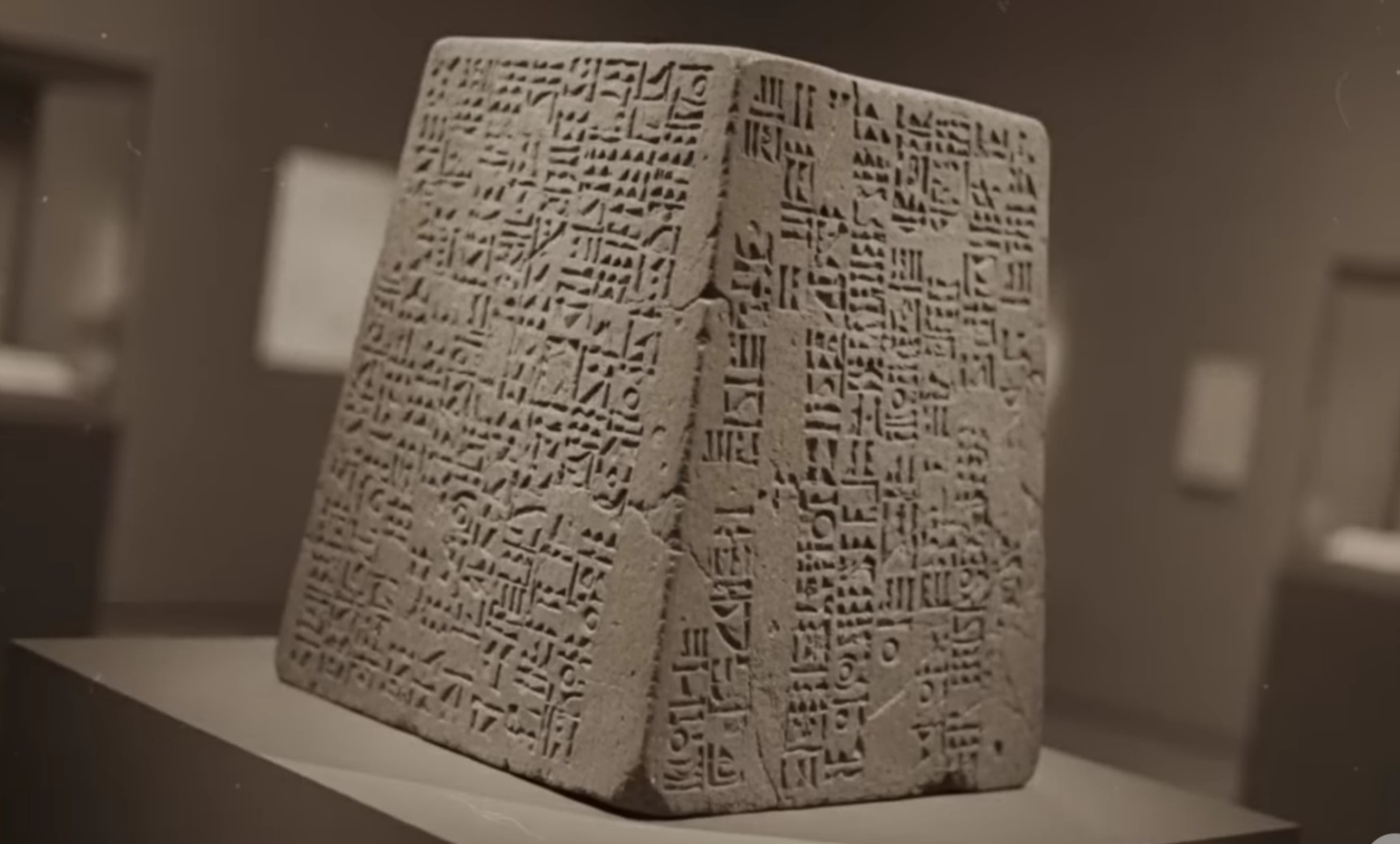
    Screenshot_20260324-195922-display-0.png~2

    The Weld-Blundell Prism, containing the King List in cuneiform script.

    The mathematical relationships encoded in the King List demonstrate predictive capabilities that allowed ancient astronomers to forecast cosmic threat patterns across multiple millennia.


    This video suggests that the the lifespans attributed to the kings on the list actually refer to astronomical data that reveal the movements, obtained by the observation of gravitational lensing, of an object that ancient texts refer to as a dark star which seems to follow Nibiru on its 3600 year orbit. Texts associate this "dark star" with predatorial, energetic parasitism, against which the Anunnaki had developed a warning system. Ancient sites were built in alignment with star systems such that gravitational lensing could be observed when the Dark Star approached that particular star system. This possibly sheds new light on the pyramids of Giza, which were built in alignment with Orion's Belt. 

    The video goes on to describe how at some point in Mesopotamian history rumours among the population spread, concerning a possible return of the sky hunters, who had driven the Nibiruans to seek refuge on Earth. Fearing that unrest would undermine his rule, King Zimri Lim ordered a narrative overwrite, from actual cosmic warfare into religious myth. This was a coordinated effort among kingdoms in various parts of the world, which sought to destroy evidence of the cosmic war, such as manuals of advanced technology and weapons, whenever the narrative overwrite wasn't possible.

    The transition from Sumerian temple schools that taught practical astronomy and engineering to Babylonian institutions focused on ritual observance and theological interpretation, represents a deliberate shift from functional education to mystical indoctrination. Priestly training programs where redesigned to emphasize symbolic interpretation rather than technical understanding, ensuring that future generations would interpret ancient records as religious allegory rather than historical documentation. The process created parallel mythological systems across different cultures that shared common structural elements while obscuring their shared technological origins.

    Some Greek philosophers saw through this process and began to "develop theories that interpreted mythological narratives as distorted historical accounts, Recognizing that divine figures represented actual historical personages whose achievements have been exaggerated through oral transmission".

    The Romans and then the Christian and Islamic world would go on to continue the Mesopotamian policy of casting historical fact into myth.
    And so, with the help of the above-mentioned excellent video, this page has morphed into an account on the practice of historical concealment, that started in ancient Mesopotamia.
    Medieval European scholarship inherited these multiple layers of concealment through translation chains that had systematically obscured technical content across multiple linguistic and cultural transitions. The recovery of ancient texts during the Renaissance reveal the extent of this historical modification, but the accumulated layers of mythological interpretation made it extremely difficult to reconstruct the original technical content. Humanist scholars recognized that classical texts contained distorted historical information, but lacked the scientific framework necessary to interpret technological references that had been preserved in fragmentary form. The development of modern archeology in the 19th and 20th centuries began to uncover physical evidence that contradicted established historical narratives, but institutional resistance to alternative interpretations prevented serious investigation of technological anomalies in ancient sites. Archaeological discoveries of advanced metallurgy, precision engineering and sophisticated astronomical instruments were consistently interpreted through conventional historical frameworks that assumed linear technological development and dismissed evidence of advanced ancient capabilities as either misidentified natural phenomena or products of unknown, but conventional techniques. The academic establishment developed systematic methods for marginalizing researchers who proposed technological interpretations of ancient evidence, creating professional incentives for maintaining conventional historical narratives, regardless of contradictory archaeological data. University departments, professional journals and funding agencies implemented peer review systems that effectively censored research, challenging established chronologies, or suggesting advanced ancient technologies. The institutional structure of modern academia perpetuated the concealment tradition established in ancient times, ensuring that evidence of cosmic conflicts and advanced technologies would remain buried beneath layers of conventional interpretation.
    Government agencies involved in archaeological research implemented classification systems that restricted access to discoveries that might challenge establish historical narratives, or reveal information about advanced technologies. Military and intelligence organizations maintained interest in ancient technical knowledge, while simultaneously preventing public access to discoveries that might indicate extraterrestrial contact or advanced prehistoric civilizations. The classification of archaeological sites and artifacts created new layers of concealment that supplemented the mythological frameworks developed in ancient times. Multimedia and educational systems continue the concealment tradition through promotion of entertainment narratives that present ancient astronaut theories as science fiction rather than serious historical investigation. A popularization of ancient mysteries through sensationalized documentaries and fictional entertainment, serves to discredit legitimate research by associating technological interpretations with fantasy and pseudoscience, The systematic ridicule of alternative historical theories creates powerful social pressure for conformity to established academic interpretations, regardless of contradictory evidence.
    Speaking of the Anunnaki, in this video someone claims to be a reincarnation of one of the seven Anunnaki scientists who coded the Adamic human DNA.